The Hidden Workforce Drain: How Aging Care Workforce Risk Is Reshaping Corporate Productivity
- Jan 14
- 4 min read
The Aging Care Workforce Risk Is a Labor‑Source Failure
Every executive understands that the U.S. population is aging. Many have personally supported an older parent or spouse. Yet despite this lived experience, most companies still treat aging‑related care as a personal matter rather than a structural labor‑market challenge.
The reality is far more consequential: The United States does not have a functioning aging‑care infrastructure for the middle class. When formal care is unavailable or unaffordable, the labor doesn’t disappear—it shifts into the home, and employers absorb the fallout.
This is no longer a social issue. It is a workforce stability issue, a productivity issue, and increasingly, a governance issue.

1. The Aging‑Care Gap Is a Labor‑Source Failure
Aging‑related care in the U.S. is delivered through a fragile patchwork:
A limited professional care workforce
High out‑of‑pocket costs
Long waitlists for home‑care support
Fragmented medical coordination
Families filling the gaps without training or resources
The result is a massive, unplanned transfer of labor from the formal economy into unpaid family care.
Caregivers routinely provide:
Medication management
Transportation to appointments
Daily living support
Crisis coordination
Complex medical tasks
24/7 supervision during health declines
This is not “helping out.” This is sustained, skilled labor that directly competes with employees’ availability, focus, and capacity.

2. The Corporate Impact Is Real—and Largely Unmeasured
Caregiving rarely appears as a line item, yet it drives measurable business outcomes:
Reduced productivity
Increased absenteeism
Unpredictable schedule disruptions
Higher burnout rates
Managerial friction
Disability claims
Voluntary and involuntary turnover
Early retirement of experienced employees
And the career impact is far more severe than most leaders realize:
16% of working caregivers have stopped working entirely for a period of time.
27% have reduced hours or shifted to part‑time roles.
13% have changed employers to accommodate care.
47% would change jobs if it meant better caregiving support.
These are not fringe numbers—they represent a structural talent drain.
At scale:
Roughly half of U.S. employees are supporting an aging family member.
A significant portion perform healthcare‑related tasks weekly.
73 million Baby Boomers are entering longer, more complex care trajectories.
This is not a niche challenge. It is a majority‑workforce reality.
Yet because employees often hide caregiving responsibilities—fearing stigma or career penalties—leaders underestimate the scope and cost.
3. Why Companies Haven’t Acted
Executives are not unaware or indifferent. The barriers are structural:
Caregiving is misclassified.
It’s treated as a personal hardship rather than a workforce‑wide operational risk.
The costs are hidden.
Caregiving impacts show up under other categories—turnover, burnout, performance issues—making the financial exposure invisible.
HR is overloaded.
Without a clear, bounded solution, caregiving feels like an unmanageable addition to an already full agenda.
Leaders fear scope creep.
They assume addressing caregiving requires sweeping policy changes rather than targeted, scalable interventions.
Employees stay silent.
Underreporting leads to underestimation.
The result is a multi‑billion‑dollar productivity drain that no one formally owns.
4. This Is Now a Governance Issue
Boards are responsible for:
Workforce continuity
Operational resilience
Risk oversight
Long‑term value creation
Aging‑care pressures touch all four.
When a large portion of the workforce is quietly absorbing healthcare labor, organizations face:
Unpredictable productivity loss
Disrupted leadership pipelines
Higher healthcare and disability costs
Gender‑equity setbacks
Loss of mid‑career and senior talent
Increased early retirement
This is not a benefits problem. It is a labor‑source problem with direct implications for shareholder value.
Boards should be asking:
“What risks are we carrying because our workforce is backfilling a missing care system?”
5. The Path Forward Is Practical and Scalable
Companies do not need to build a national care system. They need to stabilize the workforce they already have.
The most effective strategies include:
Normalize caregiving as a standard workforce reality.
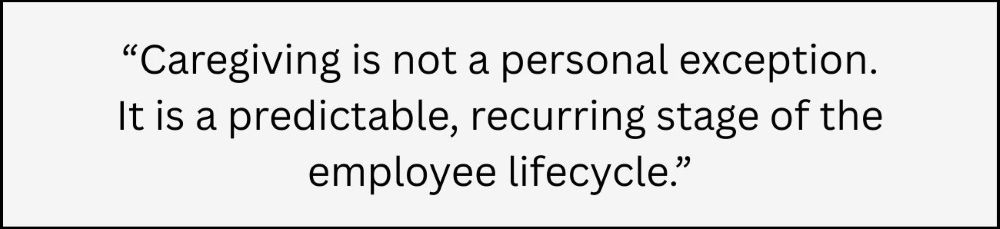
Not an exception. Not a crisis. A predictable demographic stage.
Provide tools that reduce the daily mental load.
Employees need structured systems to coordinate care, communicate with family, and stay organized—not concierge services or high‑cost benefits.
Train managers to respond with clarity and consistency.
Manager behavior is the single biggest predictor of whether caregivers stay or leave.
Offer predictable flexibility.
Not unlimited flexibility—predictable flexibility that reduces chaos for both employees and managers.
Measure the impact.
What gets measured gets resourced.
These interventions are low‑cost, high‑ROI, and immediately implementable.
6. Why This Matters Now
The demographic curve is accelerating. The care workforce is shrinking. Medical complexity is rising. Families are absorbing more responsibility than ever before.
This is not a future problem. It is a current operational drag that will intensify every year for the next two decades.
Companies that act now will:
Retain experienced talent.
Reduce burnout.
Strengthen leadership pipelines.
Improve gender equity.
Lower healthcare and disability costs
Build a more resilient workforce.
Companies that delay will continue paying for caregiving indirectly—through lost productivity and preventable turnover.
7. Connecting the Dots: A Broader Workforce Strategy
This article outlines the structural and economic forces reshaping the workforce. Two additional pieces expand on the operational and financial implications:
The ROI of Caregiver Resilience—a deeper look at the financial upside of stabilizing employees who are managing care.
Caregiving Is Not Sustainable Without Support—an examination of why current workplace norms are failing and what that means for talent retention.
Together, these articles form a cohesive executive narrative: aging‑related care is a predictable workforce reality, a measurable financial exposure, and a solvable operational challenge.
The Workforce Is Already Paying the Price
Aging care workforce risk is reshaping corporate productivity and exposing companies to hidden operational and financial vulnerabilities. Caregiving is not a personal anomaly—it is a predictable, measurable, and recurring workforce reality. Organizations that act now will gain an advantage in talent, productivity, and long‑term resilience, while those that ignore the issue will continue funding a missing care system with their workforce at enormous cost.
If your organization is exploring ways to support employees who are navigating aging‑related care, SimpliTend offers practical, scalable tools that reduce the daily mental load and help stabilize productivity. Reach out (contact.us@SimpliTend.com) if you’d like to learn more.


Comments